
The use of algorithmic underwriting is increasing across the insurance industry. With improved decision-making and risk assessments, an algorithmic underwriting approach can optimize operations for insurers and the experience for their customers.
In this post, we explore the development and benefits of algorithmic underwriting and share our insights on building and scaling an algorithmic underwriting platform.
The development…
Algorithms have always been part of the underwriting process, but have generally been limited to rating. For example, determining risk factors for automobile insurance would use algorithms or mathematical formulas to set rates based on vehicle make, model, driver age, location and history. Whether simple or complex, algorithms have long been our central assessment tool.
The use of algorithms in other areas of the underwriting process has been limited due to concerns that these factors could overlap with rate design or simply because of a lack of data and analytical decision-making capabilities in other parts of the underwriting process. Instead, the insurance industry has typically relied on complex regulatory systems to make decisions about risk acceptance, risk levels and reporting sequence.
With advances in data access and analytics tools, insurance carriers are now rethinking the use of algorithms and using them either alone or in conjunction with traditional rules engines to improve decision-making throughout the underwriting process.
How it works…
Algorithmic underwriting uses analytical models to automate decision-making in the underwriting process or provide insights to support underwriters. For more homogeneous risks, underwriting can be fully or partially automated.
Key decisions made using algorithmic underwriting:
- Determining whether a submission meets the carrier’s risk appetite
- Identify key risk characteristics such as the correct SIC/NAIC code
- Prioritize accounts based on attractiveness and winnability
- Make risk determinations for part or all of the risk
This approach allows carriers to achieve faster risk acceptance or rejection and reduce underwriting workload. It also helps provide customers with more personalized risk assessments, real-time risk management and a seamless experience.
5 Benefits of Algorithmic Underwriting
Algorithmic underwriting significantly benefits the insurance industry in five key areas:
- Process efficiency: By automating the underwriting process, algorithmic underwriting reduces turnaround times by up to 50%, streamlines operations, increases testing speed, and simplifies the maintenance of complex decision systems. Additionally, the automated processes of algorithmic underwriting can help manage up to a 25% increase in verified applications, allowing insurers to increase their premiums without additional operational costs.
- Accuracy: The accuracy of risk assessments can be improved by analyzing larger data sets. These analyzes help identify patterns and correlations that human underwriters alone may miss. This expansion of the underwriter’s insight and judgment can minimize risk assessment errors and make fraud easier to detect. We estimate that fraud losses can be reduced by up to 30% for some insurance companies.
- Price: Improved risk assessments allow pricing decisions to be made more precisely. Algorithmic underwriting helps to adapt premiums to individual risk profiles and increase customer satisfaction and competitiveness. Additionally, it supports dynamic pricing and adjusts premiums in real-time based on changing risk factors, which we estimate improves underwriting profitability by up to 20%.
- Proactive risk management: Algorithms can help insurers proactively identify emerging risks and adapt their underwriting and risk management strategies. This can help mitigate potential losses, reduce loss ratios, and improve overall portfolio performance.
- Customer experience: Algorithmic underwriting enables instant or near-instant decisions about coverage eligibility, pricing and personalized offers. With predictive and prescriptive analytics, insurers can make contextual offers in real time, making insurance more accessible and relevant to the needs of individual customers. This also makes insurance more accessible to customers or segments that may have been marginalized by past underwriting methods.
Building an algorithmic underwriting platform at scale
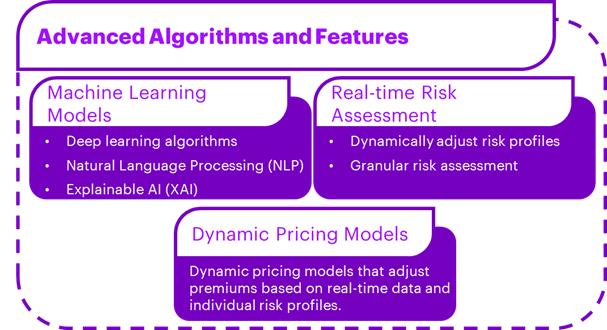
An algorithmic underwriting platform requires a layered approach that takes future scalability into account. Advanced features required when considering an algorithmic underwriting platform include machine learning models, real-time risk scoring, and dynamic pricing models.
Challenges to consider when optimizing your data and algorithmic underwriting platform:
- Data quality and availability: The data may be fragmented, incomplete or out of date.
- Model interoperability: Complex machine learning algorithms used for underwriting can lack transparency and interoperability, making it difficult to explain the results.
- Compliance: As regulation of algorithmic models and AI increases, insurers must stay ahead of the curve and adapt models as needed.
- Fairness and bias: If algorithmic underwriting is not addressed proactively, it risks perpetuating unfair practices and historical biases.
- Privacy and Security: Algorithmic underwriting involves collecting, processing and storing large amounts of personal and sensitive data. Protecting customer data is critical to compliance and maintaining customer trust.
Success stories…
We see successful examples of algorithmic underwriting across the industry. In the P&C area, for example Ki insurance uses AI and algorithms for instant commercial insurance quotes and automated policy issuance. Hiscox worked with Google Cloud to develop an AI model that automates underwriting for certain products. On the life insurance side, however ethos uses machine learning to assess risks and offer simplified insurance applications.
Diploma
Although algorithmic underwriting is not a new concept in insurance, it is revolutionary as it improves access to new data sources, data quality and analytical tools. These improvements give underwriters insights into other areas of the value chain and expand their options beyond outdated models or knockout rules.
Despite their complexity, insurers must be aware of the possibility of bias and lack of transparency in algorithmic underwriting models. Ethics and compliance, including data protection, consumer protection and fair lending laws, present challenges that insurers must address from the outset.
As technology evolves and data analysis capabilities expand, we are witnessing how algorithmic underwriting will revolutionize the insurance industry, driving innovation and enabling financial institutions to make more informed, data-driven decisions.